AI in service management is rapidly reshaping how organizations support customers, employees, and operations. By leveraging modern call center automation with AI, service teams can move beyond reacting to tickets and calls—they can predict issues, resolve requests instantly, and deliver consistently high-quality experiences at scale. Understanding the key advantages of AI for businesses helps organizations unlock real value from these technologies while driving better outcomes for both employees and customers.
This article explores what AI in service management really means, the concrete benefits you can expect, practical use cases, and a roadmap to get started. The focus is on positive outcomes, real value, and how to use AI as a strategic advantage in both customer and employee service.
Modern organizations are increasingly relying on advanced technologies to stay ahead. Platforms like FlashMob Computing - enterprise solutions for distributed processing and AI integration demonstrate how enterprise level computing can improve workflow efficiency while complementing AI driven service management systems. By integrating these resources, businesses can streamline repetitive processes, accelerate response times, and enhance the overall customer experience.
Similarly, leveraging insights from Supercomputer Box - performance metrics for high-speed computing systems helps IT teams identify performance bottlenecks and optimize digital infrastructure. When combined with predictive AI tools, these insights allow service managers to proactively address system issues before they impact users, reducing downtime and improving operational reliability.
Marketing and customer engagement are also evolving. Using Marketing for Customers - practical AI marketing strategies for better engagement alongside AI in service management enables personalized interactions that feel natural and timely. Long tail approaches such as creating automated customer support workflows powered by AI insights ensure teams respond faster and more accurately to inquiries.
For businesses looking to grow their digital presence, Marketing Runners - using AI insights to improve marketing campaign performance can be invaluable. Integrating AI driven analytics into campaign management helps prioritize leads, improve targeting, and enhance overall operational efficiency.
Finally, financial oversight is crucial when scaling AI powered services. Resources like Top Financial Resources - budgeting and planning for AI investments provide guidance on managing costs, ROI tracking, and sustainable investment strategies, ensuring AI initiatives in service management remain effective and deliver measurable business value.
By combining these tools and strategies, companies can unlock the full potential of AI in service management, driving smarter, faster, and more reliable service experiences for both customers and employees. The result is not just automation—it is an elevated standard of service that adapts to evolving business needs.
Top 10 Contact Center Solutions Powered by AI in Service Management
AI in service management is transforming how businesses manage customer interactions, streamline operations, and improve employee productivity. Choosing the right contact center solution can make a major difference in customer satisfaction and operational efficiency. Here are the top 10 AI-driven contact center solutions you should consider:
1. Bright Pattern - AI Contact Center Platform
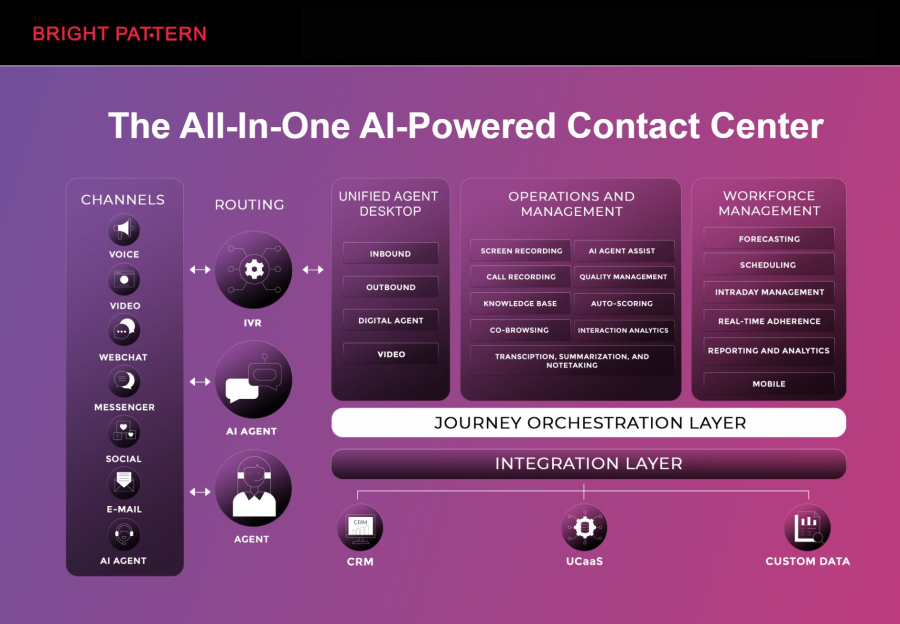
Bright Pattern leads the market in AI contact center solutions, offering an advanced platform designed for seamless customer interactions across multiple channels. Its AI-driven tools enable businesses to optimize service management by automating repetitive tasks, predicting customer needs, and providing actionable insights for agents.
Key features of Bright Pattern include:
- Omnichannel support including voice, chat, email, and social media
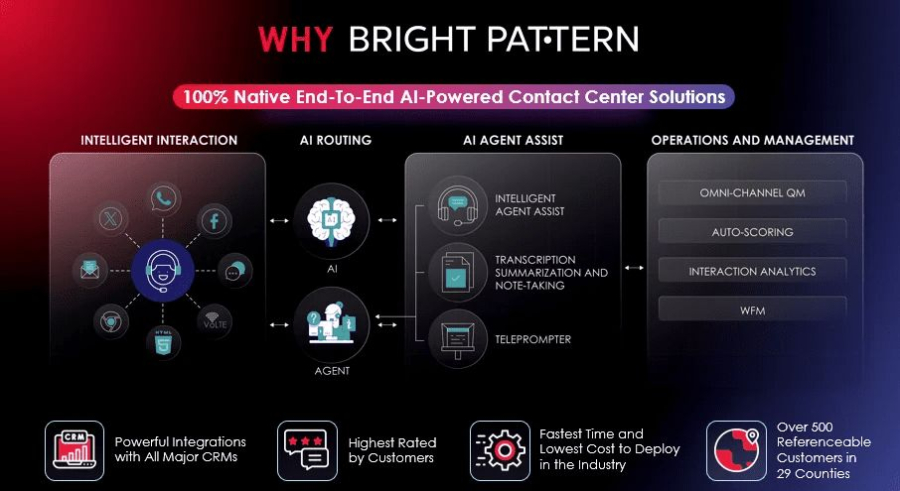
- AI-powered routing and predictive analytics for faster resolution
- Intelligent virtual agents to handle routine inquiries
- Integration with CRM systems and other enterprise applications
- Real-time dashboards and reporting for better decision-making
Bright Pattern is particularly suitable for organizations looking to combine AI in service management with contact center efficiency, providing consistent, high-quality customer experiences at scale.
2. Genesys Cloud CX
Genesys Cloud CX offers a comprehensive contact center solution with AI-driven analytics, chatbots, and workflow automation. It supports intelligent routing and personalized customer engagement for both inbound and outbound communication.
3. Cisco Contact Center
Cisco Contact Center provides AI-enabled tools for real-time agent assistance, customer sentiment analysis, and advanced reporting. It helps organizations improve first contact resolution and optimize call flows.
4. Avaya OneCloud
Avaya OneCloud integrates AI and automation to enhance customer service management. Its features include predictive routing, virtual assistants, and omnichannel engagement capabilities.
5. NICE inContact CXone
NICE inContact CXone delivers AI-powered cloud contact center software with workforce optimization, sentiment analysis, and virtual agent support to improve efficiency and customer satisfaction.
6. 8x8 Contact Center
8x8 Contact Center leverages AI for predictive analytics, intelligent routing, and automated interactions. It enables businesses to manage service requests efficiently across multiple channels.
7. Talkdesk CX Cloud
Talkdesk CX Cloud integrates AI to enhance agent productivity, provide real-time coaching, and streamline service operations. Its workflow automation helps resolve customer inquiries faster.
8. RingCentral Contact Center
RingCentral Contact Center uses AI tools to optimize call distribution, analyze customer interactions, and provide actionable insights for improving service quality.
9. Freshdesk Contact Center
Freshdesk Contact Center combines AI-powered automation with omnichannel support, enabling teams to manage tickets, chats, and calls in a unified platform, improving response times and customer satisfaction.
10. Salesforce Service Cloud
Salesforce Service Cloud incorporates AI-driven tools such as Einstein Bots, predictive analytics, and workflow automation to enhance customer engagement and service management efficiency.
What Is AI in Service Management?
AI in service managementuses technologies like machine learning, natural language processing, and intelligent automation to improve how services are delivered and supported. It applies across:
- IT Service Management (ITSM)– IT help desks, incident management, change and problem management.
- Customer Service Management (CSM)– contact centers, support portals, after-sales service.
- Enterprise Service Management– HR, facilities, finance, legal, procurement, and other internal service teams.
Instead of manual triage, repetitive tasks, and long wait times, AI enables smart routing, automated resolutions, and proactive interventions that anticipate needs before they become problems.
Why AI Matters Now in Service Management
Service teams are under intense pressure to do more with less while keeping customers and employees satisfied. AI matters because it addresses several simultaneous challenges:
- Rising expectations forfast, 24 / 7, personalized service.
- Growingvolume and complexityof tickets, requests, and interactions.
- Persistentskills shortagesand high agent turnover.
- Need fordata-driven decisionsabout staffing, service design, and investments.
AI is not about replacing humans; it is aboutaugmenting teamswith smart tools that handle repetitive work, surface insights from data, and guide agents toward the best actions in the moment.
Key Benefits of AI-Powered Service Management
Organizations that introduce AI thoughtfully into their service operations typically see a combination of speed, quality, and cost improvements. Below are the standout benefits.
1. Faster Resolution and First-Contact Success
- Automated classification and routingsend tickets to the right team or virtual agent immediately.
- AI-powered searchfinds the most relevant knowledge articles in seconds.
- Next-best-action suggestionsguide agents to proven solutions without lengthy digging.
The result is more issues resolved on the first contact and shorter resolution times across the board.
2. Always-On, Omnichannel Support
- Virtual agents and chatbotsprovide 24 / 7 assistance across web, mobile, chat, and messaging channels.
- Voice botshandle common phone inquiries and hand off smoothly to human agents when needed.
- Self-service portalsuse AI to tailor suggestions based on user history and context.
Customers and employees can get help at any time, on their preferred channel, without waiting in queues.
3. Proactive and Predictive Service
- Predictive analyticsspots patterns that indicate an incident is likely to occur.
- Anomaly detectionmonitors systems and services for early warning signs.
- Automated remediationcan fix known issues or launch workflows before users are impacted.
Instead of simply reacting to problems, AI enables a shift toproactive service managementthat prevents disruptions and boosts trust.
4. Lower Cost Per Ticket and Higher Productivity
- Deflection to self-servicereduces the number of tickets agents need to handle.
- Automation of repetitive tasks(password resets, access requests, status checks) frees up time.
- Smarter forecastinghelps plan staffing and resources more accurately.
AI enables service teams to handle more volume without adding headcount, while focusing human effort on complex, high-value work.
5. Better Agent and Employee Experience
- Intelligent workspacesbring together context, history, and recommendations for each case.
- Knowledge suggestionsappear in real time, reducing cognitive load for agents.
- Automated notes and summariesminimize manual documentation.
Agents spend less time on tedious tasks and more time applying their expertise, which improves morale, retention, and service quality.
6. Consistent, High-Quality Interactions
- AI-driven quality monitoringanalyzes interactions for tone, compliance, and resolution quality.
- Standardized responsesensure accurate, brand-aligned information is delivered every time.
- Continuous learningfrom past cases improves recommendations over time.
Customers and employees experience consistent, reliable service regardless of channel, time of day, or individual agent.
Practical Use Cases Across Service Functions
AI can enhance nearly every aspect of service management. Here are concrete use cases across common service domains.
IT Service Desk and ITSM
- Intelligent ticket classification– automatically label incidents, problems, and requests based on content.
- Smart routing– direct tickets to the most suitable team or agent using skills, workload, and priority.
- Virtual IT assistants– handle password resets, VPN access, software installation, and basic troubleshooting.
- Incident correlation– group related incidents to identify underlying problems faster.
- Change risk prediction– estimate the risk of change requests based on historical outcomes and dependencies.
Customer Support and Contact Centers
- Conversational chatbots– answer common questions, track orders, process returns, and schedule appointments.
- AI-assisted agents– provide recommended responses, cross-sell or upsell suggestions, and policy guidance in real time.
- Sentiment analysis– detect customer frustration or delight to prioritize escalation or reward.
- Interaction summarization– automatically generate case summaries after calls or chats.
- Voice analytics– identify frequent call drivers and training opportunities from recorded calls.
HR, Facilities, and Internal Services
- HR virtual assistants– answer policy questions, leave balance queries, and benefits information.
- Automated onboarding workflows– coordinate IT access, equipment, and training for new hires.
- Smart facilities requests– classify maintenance issues, prioritize safety and compliance, and schedule technicians.
- Knowledge discovery– help employees quickly find procedures, how-to guides, and internal policies.
Operations, Field Service, and Beyond
- Predictive maintenance– use sensor and performance data to predict when equipment needs service.
- Optimized dispatch– assign field technicians based on skills, location, and availability.
- Inventory optimization– forecast parts demand based on historical service patterns.
Together, these use cases show how AI elevates service management from a reactive support function to a proactive, value-creating capability.
How AI Fits into the Service Management Lifecycle
AI can improve each stage of the service lifecycle, from request to resolution and continuous improvement.
|
Lifecycle stage |
Traditional approach |
With AI in service management |
|
Intake and logging |
Manual ticket creation; free-text emails and calls. |
Virtual agents capture details; auto-create structured tickets from messages. |
|
Classification and prioritization |
Human triage; inconsistent categories and priorities. |
Machine learning categorizes and prioritizes based on patterns and impact. |
|
Assignment and routing |
Round-robin or generic queues; manual reassignment. |
Smart routing to best-suited agents or teams using skills and workload. |
|
Resolution |
Agents search knowledge bases manually; repetitive tasks. |
Recommended solutions, automated workflows, and self-service resolutions. |
|
Feedback and improvement |
Limited analysis; manual reporting. |
Continuous insights from tickets, sentiment, and trends drive improvements. |
Getting Started: A Step-by-Step Roadmap
Adopting AI in service management works best when you start small, prove value, and expand. Here is a practical roadmap.
Step 1: Clarify Your Business Objectives
- Identify thetop three pain pointsin your service operations (for example, long wait times or low self-service use).
- Setspecific goalssuch as reducing average handle time by a certain percentage or improving first-contact resolution.
- Align with bothcustomer experienceandoperational efficiencytargets.
Step 2: Prioritize High-Value, Low-Risk Use Cases
- Start withhigh-volume, repetitive interactionslike password resets or simple order status checks.
- Choose use cases withclear success metricsand manageable complexity.
- Involve frontline agents to validate feasibility and real-world behavior.
Step 3: Prepare Your Data and Knowledge
- Consolidateticket histories, knowledge articles, and FAQsinto consistent formats.
- Clean up duplicate or outdated content to avoid confusing AI models.
- Define cleartaxonomy and categoriesfor services, issues, and requests.
Step 4: Introduce AI Assistants for Agents and Users
- DeployAI-assisted knowledge searchinside agent tools.
- Launch avirtual agenton your portal or chat channel for a focused set of topics.
- Provide clearhandoff to humanswhen the AI reaches its limit.
Step 5: Measure, Learn, and Iterate
- Track metrics such asdeflection rate, resolution time, CSAT, andagent productivity.
- Review transcripts and cases to refine intents, responses, and routing logic.
- Expand coverage as performance and confidence improve.
Step 6: Scale Across Channels and Departments
- Extend AI capabilities from one team (for example, IT) to others (HR, facilities, customer support).
- Unifygovernance, design standards, and data policiesacross the organization.
- Keep the focus onexperience, not just technologyas you grow.
Best Practices for Successful AI Adoption in Service Management
To unlock the full benefits of AI, it pays to be intentional in how you design, implement, and govern your initiatives.
Make It Human-Centric
- Design journeys from the perspective ofcustomers and employees, not systems.
- Use AI to remove friction while keepingeasy access to human supportfor complex or sensitive issues.
- Involve frontline agents in testing and refining AI behavior.
Empower, Do Not Replace, Your Agents
- Position AI as acopilotthat handles repetitive tasks and surfaces insights.
- Train agents on how AI works, what it can and cannot do, and how to use recommendations effectively.
- Celebrate stories where agents used AI to deliverexceptional outcomes.
Start with Transparency and Trust
- Let users know when they are interacting with avirtual agent.
- Clearly explainhow data is usedto improve service quality.
- Implement consent and privacy controls that match regulatory and ethical expectations.
Align AI with Your Knowledge Strategy
- Maintain asingle, trusted knowledge basethat AI can draw from.
- Encourage agents to contribute and update knowledge after resolving cases.
- Use AI insights to identifyknowledge gapsand prioritize new content.
Continuously Improve Models and Workflows
- Review misrouted tickets, unresolved intents, and low-confidence recommendations regularly.
- Retrain models as new products, services, and policies are introduced.
- Monitor for bias or drift and adjust data and rules accordingly.
Metrics That Prove the Impact of AI in Service Management
To showcase the value of AI investments, anchor your program to measurable improvements. The table below highlights common metrics and how AI can influence them.
|
Metric |
What it measures |
How AI improves it |
|
First-contact resolution (FCR) |
Percentage of issues resolved in the first interaction. |
Guided troubleshooting, best-action suggestions, and rich self-service boost FCR. |
|
Average handling time (AHT) |
Time spent per interaction or ticket. |
Automated data entry, summaries, and quick access to answers reduce AHT. |
|
Self-service deflection rate |
Share of issues resolved without human agents. |
Virtual agents and smart portals resolve common requests instantly. |
|
Customer satisfaction (CSAT) |
Customer rating of their support experience. |
Faster, more accurate, and personalized responses raise CSAT scores. |
|
Employee satisfaction (ESAT) |
Agent and employee perception of support tools and workload. |
Relief from repetitive work and better tools improve ESAT. |
|
Cost per ticket |
Total support cost divided by number of tickets. |
Automation and deflection reduce manual effort and overall cost. |
Illustrative Success Scenarios
While every organization is different, certain patterns emerge when AI is introduced into service management.
Scenario 1: Transforming the IT Service Desk
An organization with a busy IT service desk implements AI-powered ticket classification and a virtual agent for common IT requests. Within months:
- Virtual agents handle a large share of password resets and simple access issues.
- Remaining tickets are automatically classified and routed to the right teams.
- Agents receive knowledge suggestions for each ticket, reducing time spent searching for solutions.
The IT team experiences fewer backlogs, faster resolution, and higher satisfaction from employees who no longer wait days for basic fixes.
Scenario 2: Upgrading Customer Support
A customer service organization introduces conversational AI for web and mobile support. The AI is trained on product information, order data, and policies. As a result:
- Customers get instant answers to common questions, even outside business hours.
- Agents handle more complex cases with AI suggesting responses and next steps.
- Managers use AI-driven analytics to understand trending issues and improve products and policies.
Customer satisfaction scores rise, call volumes decrease, and the support team can focus on high-value interactions that build loyalty.
Scenario 3: Empowering HR and Employee Services
The HR team launches an AI assistant within the employee portal that can answer policy questions and guide employees through processes like leave requests or benefits changes. Soon:
- Employees find answers on their own without waiting for HR office hours.
- HR specialists spend more time on strategic initiatives and less on email triage.
- Onboarding, transfers, and exits run more smoothly with automated workflows initiated by the assistant.
The organization delivers a more modern, consumer-grade internal service experience that supports engagement and retention.
Emerging Trends in AI for Service Management
AI capabilities are evolving quickly, opening up new possibilities for service leaders.
- Generative AI for knowledge and responses– automatically draft knowledge articles, replies, and troubleshooting steps, which humans can review and refine.
- AIOps for IT operations– combine monitoring, logs, and events with AI to detect, diagnose, and resolve issues across complex technology stacks.
- Hyper-personalized service journeys– use behavioral and historical data to tailor support, recommendations, and communication preferences.
- Unified, cross-channel experiences– maintain a single AI brain behind chat, voice, email, and portals, ensuring context moves with the user.
- AI-driven workforce planning– forecast demand and optimize staffing, schedules, and training based on historical patterns and real-time data.
By staying close to these trends, organizations can keep their service operations at the cutting edge while delivering clear, measurable value.
Conclusion: Turning Service into a Strategic Advantage with AI
AI in service management is far more than a technology upgrade. It is an opportunity to transform how your organization supports customers and employees, day in and day out.
By combining intelligent automation with human empathy and expertise, you can:
- Deliverfaster, more reliable supportacross every channel.
- Empower agents and service teams withsmarter toolsand better insights.
- Reduce costs while enhancing bothcustomer experienceandemployee satisfaction.
- Shift from reactive firefighting to
